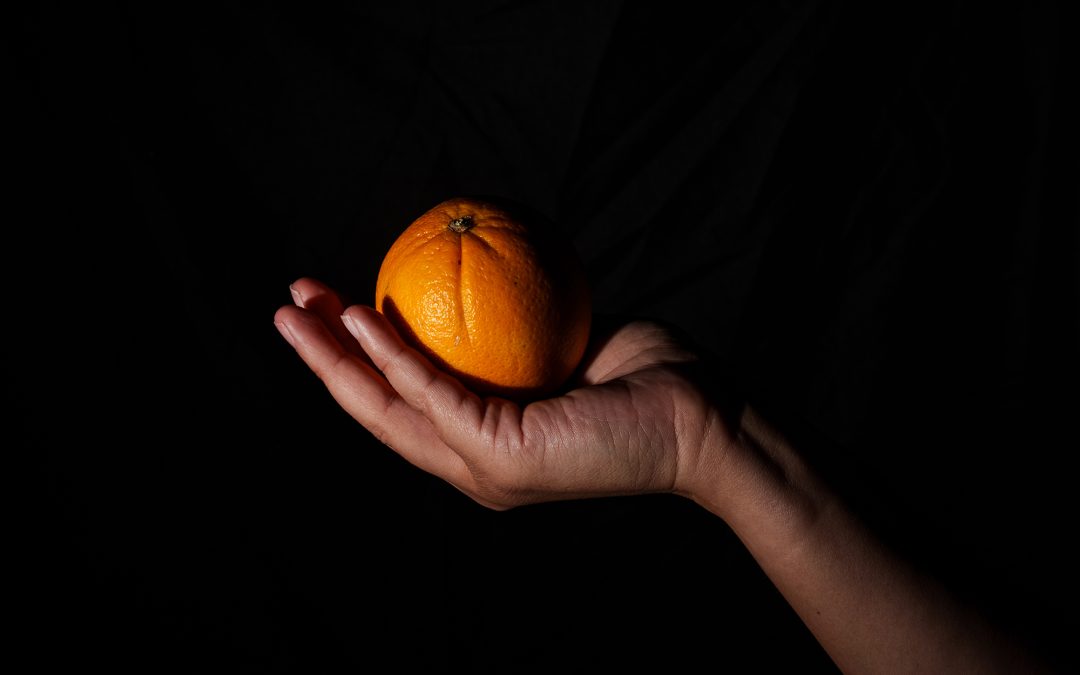
Image: Bianca Joanna Buliga, Portocala, 2026, Photography, 75cm x 100cm, image courtesy the artist.
Hidden in Plain Sight
12 October 2026 – 29 January 2027
Adelaide Airport
Curator: Maz McGann
Featuring: Abbey Murdoch, Bianca Joanna Buliga, Catherine Fitz-Gerald, Chloe Noble, Emiko Artemis, Gus Clutterbuck, Katherine Grocott, Makeda Duong, Meg Mader, Tabitha Lean, Tieyuan (Vivian) Zhou, Tom Phillips
Hidden in Plain Sight is presented by Guildhouse and delivery partner Adelaide Airport, with generous support from The Wyatt Trust.
We tend to think we know what poverty looks like. This exhibition, Hidden in Plain Sight asks us to look more closely.
Most of us carry an image of poverty in our heads. We might picture homelessness, unemployment, food relief, crisis accommodation or someone visibly struggling to get by. These experiences are real, but they represent only part of a much larger and more complicated picture.
Poverty can look remarkably ordinary.
It can exist in a family home that is clean, safe and filled with books and imagination. It can sit alongside employment, creativity, parenthood, humour and ambition. It can be present in a regional community dealing with drought, flood or isolation; in a household managing illness or disability; in the insecurity of housing; or in the choices quietly made when there is simply not enough money to meet every need.
It can be experienced for a period of a life or across generations. It can arrive suddenly through illness, separation, unemployment or disaster, or accumulate gradually through low income, rising costs and insecure work. Sometimes it is visible. Sometimes it is deliberately concealed. And sometimes it is right in front of us, but we do not recognise it because it does not resemble the picture of poverty we expect to see.
The scale should challenge that picture. More than one in seven Australians around 3.7 million people live below the poverty line, including around one in six children. Yet Australia has no official national measure of poverty. Behind those numbers are millions of individual lives that cannot be adequately described by a statistic.
This distinction is central to Hidden in Plain Sight.
The exhibition brings together twelve South Australian artists whose lived and living experiences offer different perspectives on financial hardship, disadvantage and the circumstances that surround them. Their experiences are diverse, as are their artistic practices and the works they have chosen to share. There is no single story of poverty here. Nor is there a single visual language through which to recognise it.
Across the exhibition we encounter domestic rooms and suburban landscapes, birds, sticks, water and drought, childhood memories, family relationships, uncertainty, confinement, humour, displacement and imagination. Some works speak explicitly about poverty or disadvantage. In others, the connection sits around or behind the work, in the circumstances in which it was made, the memory it holds, the choices that were available at the time, or the story the artist chooses to tell alongside it.
That complexity is important.
Across the works, hardship exists alongside other things: love, humour, imagination, creativity, family, beauty, anger, memory and hope. There are childhoods shaped by financial constraint but also rich in imagination and care; homes that provide comfort while carrying uncertainty; landscapes that hold beauty alongside drought, flood and loss; and experiences of illness, displacement, confinement and insecurity that intersect with lives in ways that are not always visible from the outside.
Together, the works remind us that financial hardship is only one part of a person’s story. Poverty can shape a life without defining it.
To recognise this is not to minimise hardship. Financial insecurity limits choices and opportunities. It creates stress and can intersect with housing, health, disability, education, employment, geography, family circumstances and people’s interactions with institutions and systems. The effects can be immediate, cumulative and intergenerational. But if we see only disadvantage when we look at someone experiencing it, we have failed to see the whole person.
This is where art offers something particular to the conversation.
Statistics are essential. They tell us about scale, patterns and inequality. Research helps us understand causes and consequences. Policy can identify interventions and solutions. But none of these necessarily changes the way we see another person.
Art can interrupt that certainty.
It can take something abstract and make it intimate. It can draw our attention to an ordinary object, room, landscape or memory and reveal another meaning within it. It can allow humour and hardship to occupy the same space. It can hold beauty alongside grief, love alongside insecurity, and resilience alongside anger or exhaustion. It can ask us to remain with complexity rather than rushing towards an explanation.
Importantly, art does not have to tell us what to think in order to influence how we think. Sometimes its most powerful contribution is to challenge an assumption, reveal another perspective or encourage us to look again.
That idea has also shaped how Hidden in Plain Sight was developed. Using a Community Arts and Cultural Development approach, the artists were not asked simply to illustrate a predetermined message about poverty. Through conversation, reflection and shared creative development, they considered what they wanted to contribute, which works they wanted to show and what stories they wanted to tell alongside them.
The artists are not simply the subjects of the exhibition; they have helped shape it. Their experiences, perspectives and artistic practices have influenced what is shared and how those stories are told.
There is something particularly fitting about encountering these works at Adelaide Airport.
Airports are places of movement and transition, filled with people whose circumstances we know almost nothing about. We pass one another carrying luggage, expectations, responsibilities, worries, histories and plans. Someone may be travelling for work, returning home, visiting family, taking a long-awaited holiday or leaving somewhere they can no longer stay.
We cannot know simply by looking.
During Anti-Poverty Week and beyond, Hidden in Plain Sight asks us to question not only what we know about poverty, but what we think we know about the people who experience it.
Perhaps poverty does not always look the way we imagine.
Perhaps hardship and a rich life are not opposites.
Perhaps there is more happening in the lives around us than we can readily see.
And perhaps, if we look a little more closely, we might begin to see one another differently.
Maz McGann
Curator
Most artworks are for sale with all proceeds going directly to the artists.
For purchase enquires please contact Guildhouse directly:
08 8410 1822 or guildhouse@guildhouse.org.au
