
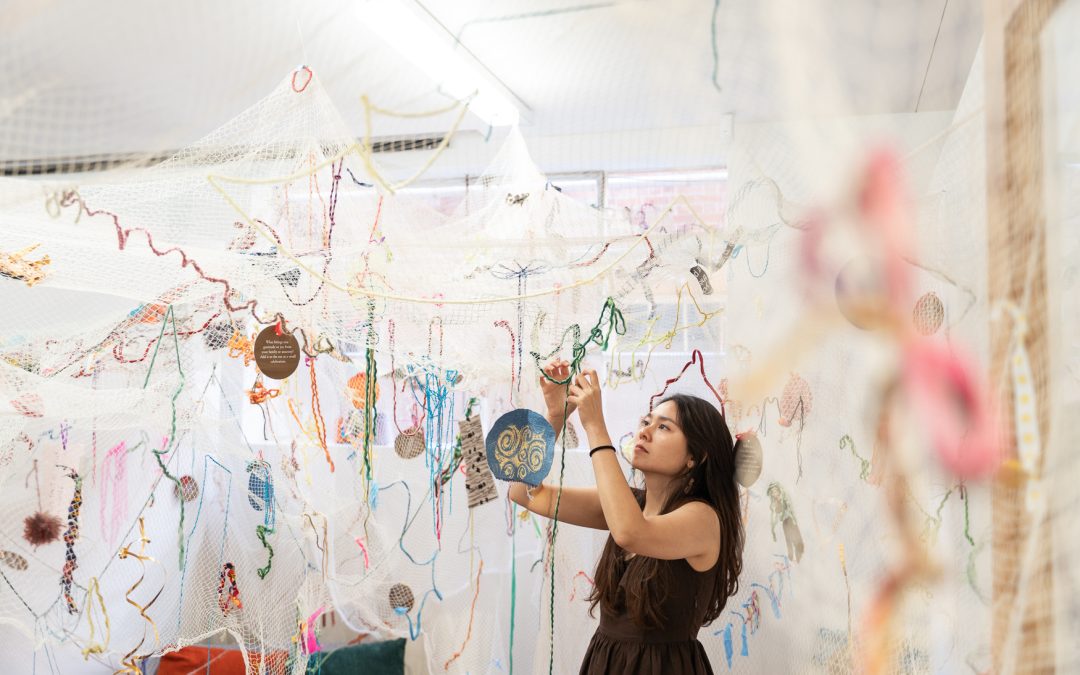
Image: Dai Trang Nguyen, To be and to be continued…, installation view, photograph Lana Adams.
Dai Trang Nguyen: to be and to be continued…
An outcome of The Guildhouse Collections Project with FABRIK
Celebratory Gathering:
Saturday 21 March 2026, 12 – 2pm
FABRIK Arts + Heritage
RSVP here
The Guildhouse Collections Project, delivered in collaboration with the state’s major cultural institutions, connects artists with significant collections to inspire new work.
This unique project that provides artists with the opportunity to research an area of one of the institution’s collections and develop new work for exhibition. Championing the art and artists of our time while celebrating our cultural, historic and scientific heritage, The Guildhouse Collections Project has demonstrated the ability to provide new audience experiences while delivering long-term benefits to the artistic and career development of participating artists.
Located in Lobethal in the Adelaide Hills, FABRIK manages extensive cultural collections, including the textile heritage of the Onkaparinga Woollen Mill, historical and community archives, and contemporary living collections of people and place.
Running from August 2025 to April 2026, this residency-style program offered an opportunity for an artist, craft practitioner, or designer to research, reflect and create new work in response to FABRIK’s rich collections, culminating in a public exhibition in early 2026.
Vietnamese-born artist and designer Dai Trang Nguyen was the inaugural recipient of the opportunity with FABRIK, and spent six months exploring the collections and developing new work in collaboration with the community.
Artist Statement:
This journey grew from my exploration of interconnectedness across time and space, where past, present and future weave through multicultural and generational heritage. Through everyday conversations, (extra)ordinary encounters and learning from community members, the lineage of FABRIK formed the conditions for me to meet my inner ancestors.
For many older Vietnamese and Asian generations, including my grandparents and parents, life was shaped by survival. There was little space to pause, breathe or enjoy a simple cup of tea. Even today, life often moves by productivity and results, and it is easy to let each step slip by. Without realising it, I have carried this inherited seed within me, deeply ingrained in body and mind, rushing to create “enough” work for the final presentation.
One afternoon at FABRIK, I lay on the grass under the sun, watching others work, and felt guilty for doing nothing. “Everyone is doing exactly what they are supposed to do,” a volunteer reassured me, and something opened inside. In that moment, I realised that creating, resting and simply being present could be profound offerings — for my ancestors and for those who rarely had the privilege to pause. Perhaps their unfinished dreams flow through me, allowing me to slow down, to rest, to feel what they once had to set aside. Ironically, what I can offer them is nothing.
In art and textiles, patience is woven into every step. Every knot, thread and small movement contributes to the whole. I think of the Onkaparinga blankets, and how former mill workers spent hours sharing how they turned wool into yarn after decades of experience, yet even that barely touches the fullness of the process. We often see only the finished piece, rarely the long journey of care, attention and countless quiet gestures that allow it to become. This journey honours those overlooked moments, where non-doing is part of doing. Non-making — threading needles, sweeping the floor, sorting yarns, resting, observing — is as meaningful as making itself.
Over six months, the work unfolded through presence and mindfulness, allowing interactions to accumulate and evolve organically. Quiet making grew into small gatherings, then open invitations for collective creation. It moved like waves through corners, staircases and studios, joining and expanding. An ever-evolving participatory installation emerged from contributed materials, layered atop the fruit tree net, and woven together by many hands.
What holds this installation is the living heritage of FABRIK: its people. Over time, the space became a contemporary expression of multicultural memory. Children tied bows for their families, and visitors from many countries added playful forms into the net. Resting beneath it feels like sleeping under the protection of a mùng, the mosquito net that cradled me as a child in Vietnam. Together, we left traces of our presence, becoming part of an ongoing story without a fixed ending.
This journey is a living continuation of me, of you and of the woollen mill. It has shifted from solitary visual art to a conceptual, community-based practice, where creating, resting and sharing become art itself. Here, past, present and future meet, woven across cultures and generations, where life and art cannot be separated. Beyond materials and technique, what we weave are the invisible threads that connect us — to ourselves, to one another and to the lineage that flows through us.
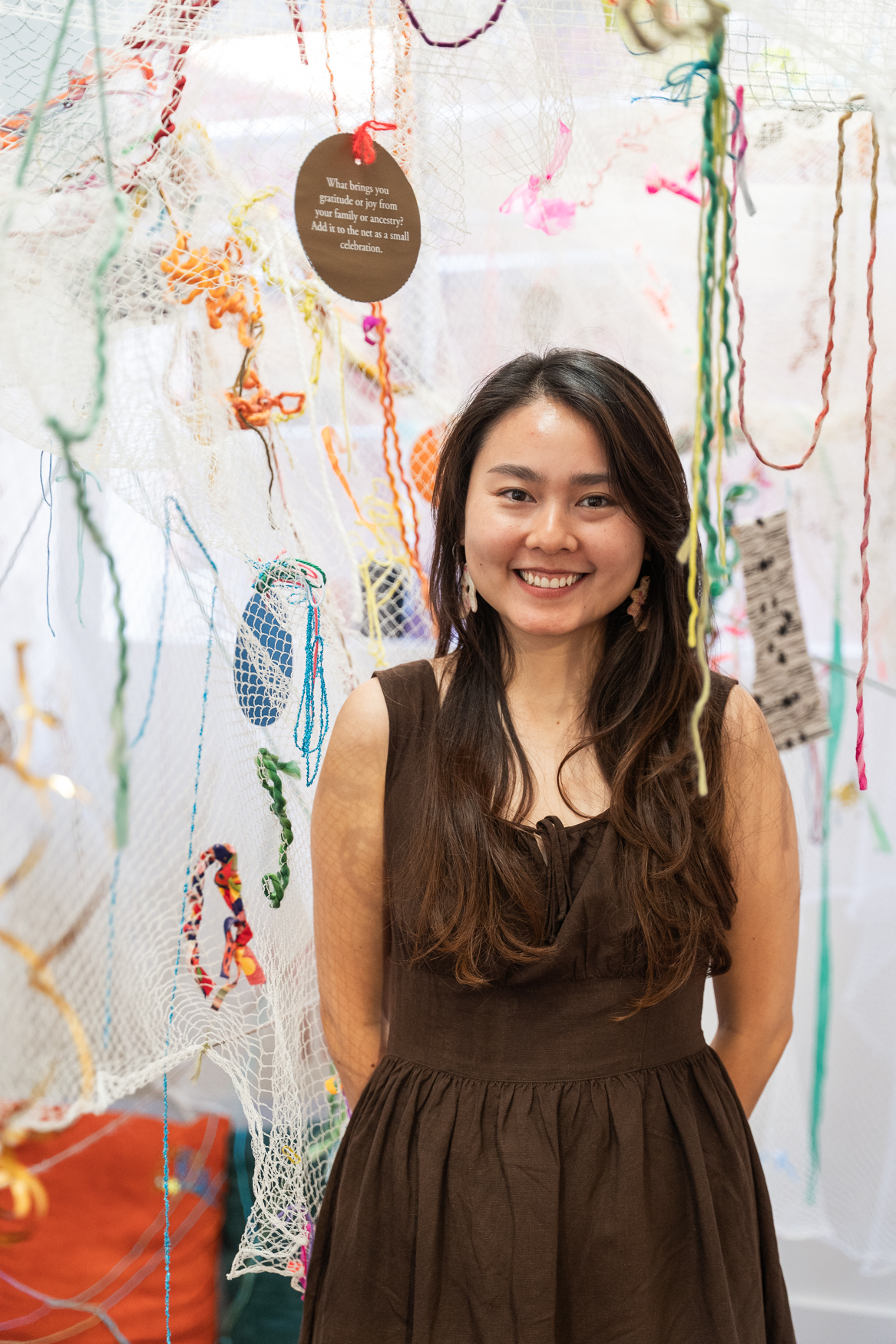
Photograph Lana Adams.
Dai Trang Nguyen is a Vietnamese artist and designer based in Kaurna Country, with a creative journey spanning Vietnam, the UK and Australia. Originally trained in communication design, her practice has evolved from structured precision to an intuitive approach rooted in mindfulness, presence and the unfolding of each moment.
During the solitude of COVID-19, art became her sanctuary and a guide for self-understanding, leading to her first solo exhibition in Vietnam and inspiring her move to South Australia in 2022 to pursue a Master’s in Contemporary Art. Since then, her practice has deepened through introspection and experimentation, expanding materially from digital illustration into tactile forms.
Living far from home has deepened her connection to her Eastern heritage. Influenced by Buddhism, her slow, embodied process embraces making as meditation – each gesture responding to internal and external conditions. Working with textiles, found objects and mixed media, she creates contemplative sculptures, wall works and installations that reflect impermanence, fluidity and interconnectedness.
